
Sustainability reporting in the Philippines is entering a new era.
Through the SEC Memorandum Circular No. 16, Series of 2025, the Securities and Exchange Commission (SEC) has formally adopted Philippine Financial Reporting Standards (PFRS) S1 and PFRS S2, requiring publicly listed companies (PLCs) and large non-listed entities (LNLs) to align their sustainability disclosures with globally recognized reporting standards.
The move signals a significant shift from voluntary sustainability initiatives toward more structured and mandatory disclosure of sustainability-related and climate-related information. The objective is clear: provide investors, regulators, and stakeholders with a better understanding of how sustainability-related risks and opportunities can affect a company’s financial performance and long-term value creation.
Among the most critical requirements under these new standards is the disclosure of greenhouse gas (GHG) emissions, making GHG accounting essential for covered companies.
To ease the transition, the SEC has adopted a phased implementation approach based on company size and market capitalization.
Covered Companies by Tier
- Tier 1
- PLCs with market capitalization above PHP 50 billion
- Tier 2
- PLCs with market capitalization between PHP 3 billion and PHP 50 billion
- Tier 3
- PLCs with market capitalization of PHP 3 billion and below
- PLCs solely listed in the Philippine Dealing & Exchange Corp. (PDEx)
- Large non-listed entities (LNLs) with annual revenue exceeding PHP 5 billion
GHG Emissions Reporting Timeline
Tier 1
- Scope 1 and Scope 2 emissions: FY 2026 (reported in 2027)
- Scope 3 emissions: beginning FY 2028
Tier 2
- Scope 1 and Scope 2 emissions: FY 2027 (reported in 2028)
- Scope 3 emissions: beginning FY 2029
Tier 3
- Scope 1 and Scope 2 emissions: FY 2028 (reported in 2029)
- Scope 3 emissions: beginning FY 2030
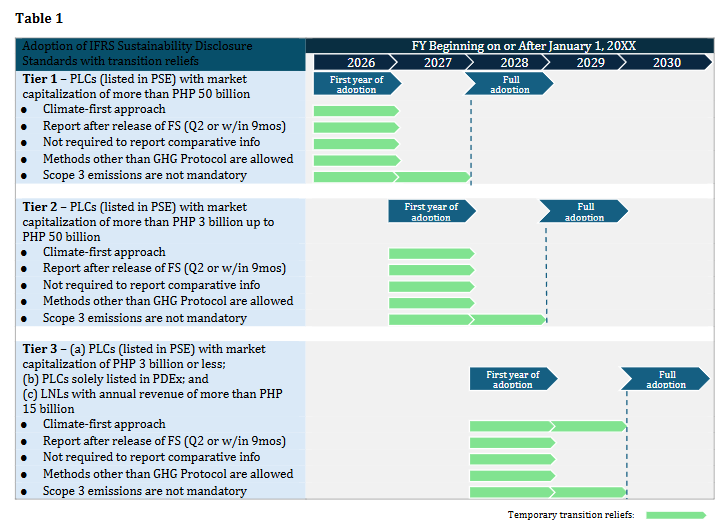
Source: Adoption of IFRS Sustainability Disclosure Standards with Transition Reliefs (p.6)
For many organizations, this means the time to prepare is now. Establishing the necessary systems, processes, and data management practices for emissions accounting can take months, if not years. Companies that wait until reporting becomes mandatory may find themselves cramming to gather historical data, identify emissions sources, and meet disclosure requirements.
Compliance begins with understanding your emissions.
Accurate GHG accounting requires organizations to identify emission sources, collect operational data, apply appropriate calculation methodologies, and maintain a reliable audit trail for reporting. While Scope 1 and Scope 2 emissions are often the starting point, many companies will eventually need to expand their efforts to include Scope 3 emissions, which can represent the majority of an organization’s carbon footprint.
Not only is sustainability reporting a compliance exercise necessary today, but it is also used by forward-thinking companies as a management tool. Reliable emissions data enables organizations to:
- Identify major emission hotspots to improve operational efficiency
- Set realistic science based emission reduction targets
- Reduce energy consumption and costs
- Strengthen ESG performance
- Enhance investor confidence
The earlier organizations establish these capabilities, the smoother their transition into the new reporting regulations will be.
At Basecheck, we believe compliance should create value, not just satisfy regulatory requirements.
Our team helps organizations understand, measure, and manage their greenhouse gas emissions through a data-driven approach. Beyond calculating annual emissions inventories, we work with companies to identify opportunities for emissions reduction, improve sustainability performance, and build a stronger foundation for long-term resilience.
By partnering with Basecheck, companies can:
- Develop accurate and defensible GHG inventories and SEC sustainability disclosure requirements.
- Establish systems for ongoing emissions monitoring and reduction.
- Enhance ESG performance and transparency with investors, customers, and stakeholders.
As sustainability disclosures become increasingly important in investment and business decisions, organizations that act early will be better positioned to demonstrate leadership, manage risk, and create long-term value.
The transition brought about by SEC MC No. 16 S. 2025 is not simply about reporting emissions. It is about understanding how sustainability affects business performance and using that knowledge to make better decisions.
Whether your organization is preparing for regulatory compliance, building its sustainability strategy, or taking its first steps into GHG accounting, our team can help you understand, measure, and manage your emissions with confidence.
The reporting deadlines may still be a few years away, but the best time to start building your GHG accounting capability is today.